

 English
 Español
 日本語
日本語At first glance, the question seems simple. A roller is a roller, and if it can carry the weight of a sliding door, many buyers assume it should perform more or less the same over time. In real-world use, that assumption rarely holds. Once the system enters daily operation, a range of variables begins to affect how it behaves — dust gradually entering the track, lubrication thinning out, contact surfaces wearing down, and alignment shifting slightly under repeated load.
That matters more in 2026 because expectations around sliding door systems have changed. It is no longer enough for a door to function properly at installation. Buyers now pay closer attention to how it performs after extended use. As architectural trends move toward larger panels, cleaner lines, and concealed hardware, any change in rolling quality becomes easier to notice. What used to be overlooked is now part of the overall perception of build quality.
The key point is this: sliding door roller wheels are dynamic components. Their performance is shaped by long-term operating conditions, not just initial specifications. A system that feels smooth on day one may behave very differently after years of repeated cycles. To understand why noise develops, it is necessary to look at what the roller experiences over time.
It Is Rarely a Single Failure
In field conditions, noise is almost never caused by one isolated issue. It is usually the result of accumulation.
What builds up in real use
Over time, the system is exposed to:
- continuous load transfer from the door panel
- repeated contact between wheel and track
- gradual entry of fine debris
- slow internal wear inside the roller assembly
Each of these factors is minor on its own. The impact comes from repetition.
Why users feel it happens "suddenly"
From a user perspective, the change often feels abrupt. In practice, the system has been shifting for months or years:
- debris settles in thin layers
- surfaces lose their original finish
- friction increases incrementally
Eventually, the system crosses a threshold where movement is no longer smooth enough to ignore.
Reading the Sound Like a Signal
Noise is not random. It reflects how the system is interacting internally.
Common sound patterns in actual use
| Sound | Likely Condition |
|---|---|
| light squeak | reduced lubrication |
| grinding | bearing contamination or wear |
| intermittent clicking | slight play in components |
| dull bumping | wheel surface deformation |
| scraping | track irregularity or misalignment |
What creates the sound
Sound develops when motion loses consistency. Even small variations in rolling resistance create vibration. Once vibration reaches a certain level, it becomes audible.
The Track: Where Problems Quietly Start
In many cases, the track is the first place where performance begins to decline, even though it receives the least attention.
What actually accumulates
- fine airborne dust
- grit carried from outside
- fibers from indoor activity
- microscopic particles from wear
These materials are not always visible. Over time, they become compacted into the track surface.
Long-term effect on movement
- rolling resistance increases
- the contact surface becomes uneven
- vibration is introduced into the system
This process is gradual, which is why it often goes unnoticed in the early stage.
Lubrication Does Not Fail All at Once
Lubrication is often assumed to remain effective indefinitely, but in practice, it changes continuously.
What happens inside the roller
- lubricant migrates away from contact zones
- it becomes thinner under repeated motion
- it mixes with fine particles and loses effectiveness
How this affects operation
- initial increase in friction
- light squeaking under movement
- gradual transition to rougher rolling
Applying lubricant can help, but excessive application may trap debris and reduce performance instead of improving it.
Wheel Wear Happens at the Contact Level
Roller wheels do not typically break. They change.
Observed wear behavior
| Material | Typical Change | Result |
|---|---|---|
| nylon | edge flattening | uneven load distribution |
| metal | surface fatigue | increased friction noise |
| composite | irregular wear zones | vibration during travel |
Why small wear matters
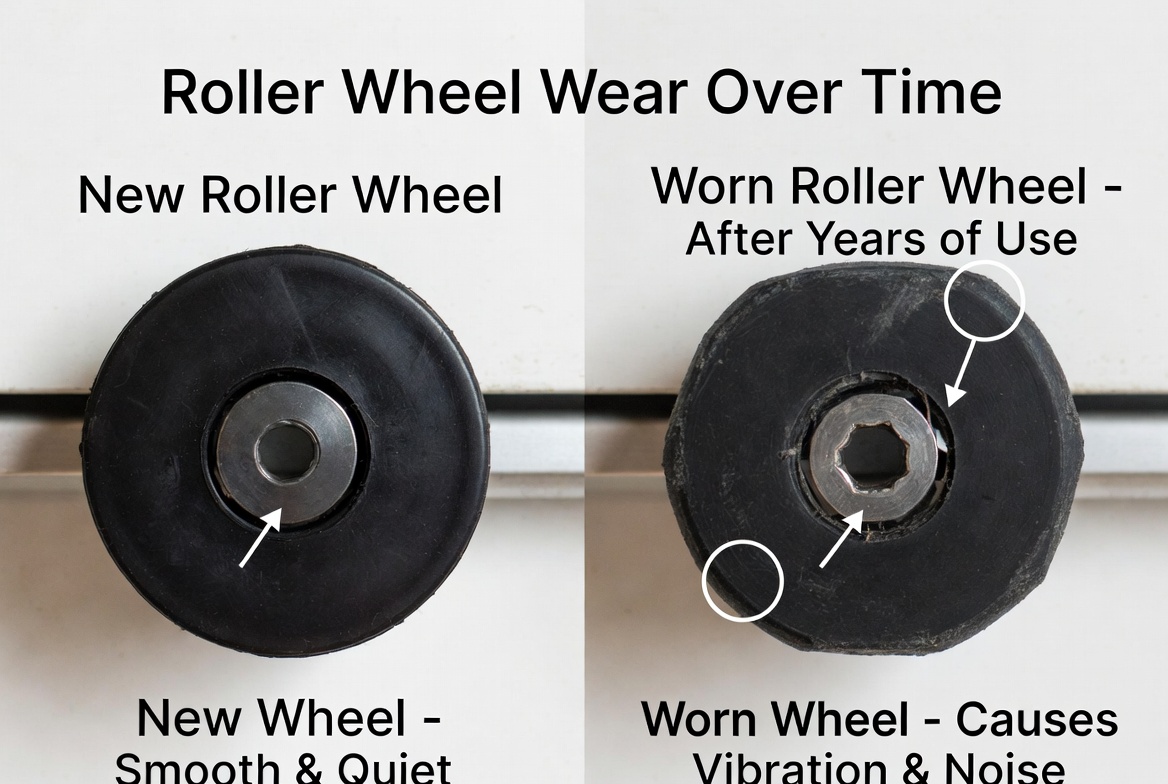
A deviation of even a small fraction from a true circular profile can introduce repeated impact during rotation. Over time, this becomes noticeable as sound.
Bearings: Hidden but Critical
Bearings are one of the most important yet least visible components.
Internal changes over time
- lubricant degradation
- entry of fine contaminants
- gradual wear of contact surfaces
Field symptoms
- grinding noise under load
- inconsistent rotation
- resistance when starting movement
In many cases, bearing condition explains why older sliding doors feel heavier even when no visible damage is present.
Track Wear Is Often Underestimated
Tracks are usually seen as static components, but they are subject to constant interaction.
What changes over time
- shallow dents from repeated load
- fine scratches caused by debris
- slight deformation under long-term pressure
Impact on performance
These changes alter the rolling path. Instead of continuous movement, the wheel encounters repeated micro-interruptions, which generate vibration.
Alignment Drift Develops Gradually
Alignment issues are not always caused by poor installation. They can develop during normal use.
Contributing factors
- gradual loosening of fasteners
- structural movement over time
- uneven usage patterns
Resulting effects
- uneven load distribution across rollers
- accelerated wear on specific components
- earlier onset of noise
The shift is often small but enough to affect performance.
Environmental Influence Never Stops
Even in controlled indoor environments, external factors still play a role.
Long-term environmental effects
- temperature changes affect material dimensions
- dry air reduces lubrication efficiency
- humidity influences metal surfaces
These factors operate continuously and contribute to gradual system change.
Why Noise Appears After Years, Not Months
The delayed appearance of noise is directly related to how these factors accumulate.
What builds over time
- debris layers in the track
- gradual material fatigue
- lubrication breakdown
- alignment drift
No single factor triggers the issue. It is the combined effect that eventually becomes noticeable.
Early Signs That Are Often Ignored
Before clear noise develops, the system usually shows subtle changes.
Common early indicators
- slightly increased effort when sliding
- less consistent movement
- sound appearing only at specific positions
These signs are often overlooked because the door still functions.
Maintenance Can Slow the Process
Routine care can delay the onset of noise, although it cannot eliminate wear entirely.
Practical maintenance steps
- cleaning the track at intervals
- removing visible debris
- applying controlled lubrication
- checking for loose components
These actions help maintain smoother operation for a longer period.
When Maintenance Is No Longer Enough
At a certain stage, maintenance does not restore performance.
Typical conditions
| Condition | Recommended Action |
|---|---|
| uneven wheel profile | replace roller |
| persistent grinding | replace roller assembly |
| track deformation | repair or replace track |
| unstable movement | adjust alignment |
Replacing worn components is often more effective than repeated temporary fixes.
Fixes That Can Accelerate Wear
Some common approaches unintentionally worsen the situation.
What to avoid
- over-application of lubricant
- use of unsuitable products
- ignoring alignment issues
- continued use of worn components
Short-term improvement often leads to faster long-term degradation.
Sliding door roller wheel begin to make noise after a few years because the system gradually moves away from its original condition. Dust accumulation, lubrication loss, material wear, and alignment changes all contribute to the shift in performance.
The reason it feels sudden is that these changes develop quietly over time. By the time they become noticeable, multiple factors are already involved.
Understanding this progression makes it easier to respond in a practical way. Whether through maintenance or component replacement, addressing the underlying causes helps restore more stable and consistent operation over the long term.