

 English
 Español
 日本語
日本語A cavity sliding door is supposed to make a space feecleaner, calmer, and easier to use. When it works well, the paneglides out of sight with barely any effort and frees up floor area that a swing door would otherwise consume. When it does not, the experience goes downhilquickly—dragging movement, rattling hardware, doors that refuse to sit level, and the kind of irritating noise that makes a supposedly modern feature feecheap.
That is why the roller system deserves far more attention than it usually gets. In 2026, buyers are no longer looking only at appearance or price. They want sliding door hardware that can cope with heavier panels, tighter design tolerances, and more demanding expectations around quiet operation and long-term reliability. Whether the project is a new build, a renovation, or a replacement job, the quality of the rollers often determines whether the whole system feels durable or disposable.
Why Rollers Matter More Than Most Buyers Think
At first glance, rollers seem like a smaldetaiin a much bigger door system. In reality, they do the work that people notice every single day.
The hidden component that controls the user experience
Once installed, the rollers are mostly out of sight. But they are responsible for:
- Carrying the weight of the door
- Guiding the panealong the track
- Reducing friction during opening and closing
- Helping the door stay level
- Supporting smooth alignment with soft-close or stopping mechanisms
If those functions are handled poorly, the symptoms show up fast. The door may scrape, wobble, feeheavy, or develop a rough sliding action long before the paneitself shows any wear.
Why the 2026 market is paying closer attention
Severacurrent design and construction trends have made roller performance a bigger issue than it was a few years ago:
- Interior doors are getting larger and heavier
- More homeowners care about low-noise living environments
- Soft-close systems are becoming a baseline expectation
- Builders and installers want fewer maintenance callbacks
- Buyers are comparing product lifespan, not just entry price
That combination has pushed more people to look beyond the visible door finish and ask what kind of hardware is supporting it behind the wall.
MateriaSelection: Where Long-Term Performance Begins
Materiachoice affects nearly every aspect of roller performance. It influences how much load the assembly can carry, how quickly the wheesurface wears, how welthe hardware resists corrosion, and how quietly the door moves.
Steerollers and steecomponents
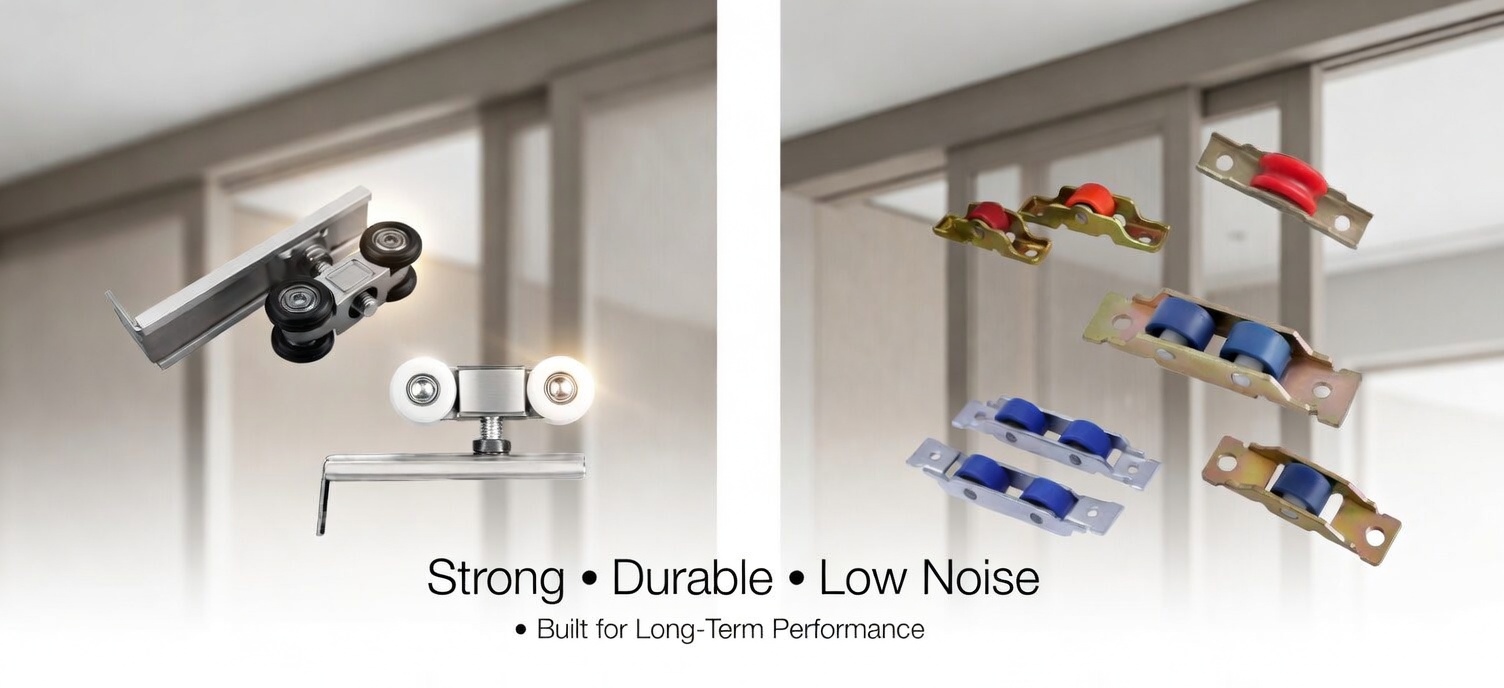
Steeremains one of the most widely used materials for heavy-duty cavity sliding door hardware.
Why it is commonly chosen:
- Strong load-bearing performance
- Good resistance to distortion under pressure
- Suitable for solid-core, timber, and oversized doors
- Dependable structurabehavior over time
Where buyers need to be careful:
- Poorly engineered steesystems can sound harsher in operation
- Protective coatings matter in humid settings
- Lower-grade steecan become vulnerable to rust
Steeis often the practicachoice when the door itself is substantial. It offers reassurance where paneweight, frequent use, or long-term structurareliability matter more than absolute quietness.
Stainless steel
For buyers concerned about moisture, long-term corrosion resistance, or higher-spec installations, stainless steeis often the safer option.
What makes it appealing:
- Better resistance to rust and corrosion
- More suitable for humid interiors and coastaproperties
- Strong durability reputation
- Lower maintenance risk over time
The detaithat often gets missed is grade. Stainless steeis not a magic labeon its own. The performance difference between grades can be significant, so buyers should pay attention to whether the hardware is intended for standard dry indoor conditions or for more challenging environments.
Nylon rollers
Nylon remains popular because it helps deliver a quieter and smoother sliding feein many residentiasettings.
Its main advantages include:
- Lower rolling noise
- Softer contact with compatible tracks
- Good wear characteristics in quality formulations
- A more refined feein everyday use
Its limitations are equally real:
- Lower-grade nylon may flatten or crack under load
- Performance can vary considerably from one manufacturer to another
- Heavy doors can shorten service life if the roller is under-specified
That does not make nylon a compromise by default. In many homes, high-quality nylon rollers are chosen because they create a better day-to-day experience than a rougher metaalternative.
POM, Delrin, and engineered polymers
At the premium end of the market, engineered polymers such as POM are often used to improve smoothness, dimensionastability, and wear behavior.
Why these materials are valued:
- Low-friction operation
- Strong shape stability over time
- Good resistance to wear
- More consistent movement across repeated cycles
- Reduced operating noise
These materials tend to shine in better-matched systems where bearings, tracks, and rollers are aldesigned to tighter tolerances. In those setups, the door feels more controlled and less mechanical.
Zinc-alloy and mixed-materiaassemblies
Many mid-range and upper-mid-range roller systems combine different materials—for example, zinc-alloy housings with polymer wheels or steel-reinforced internaparts.
Load Capacity: Why Rated Weight Is Not the Whole Story
Load rating is one of the first numbers buyers look for, but it can be misleading when considered in isolation.
A door does more than just hang there
A roller set may be rated for a certain weight, but once the door is in daily use, the system experiences more than static load alone.
That includes:
- Repeated opening and closing
- Minor impacts
- Sudden stops
- Uneven pressure if installation is not perfect
- Long-term stress on bearings and hangers
A roller system that technically "matches" the door weight may stilbe under strain in real-world use.
Why a safety margin matters
Experienced specifiers usually leave headroom between actuadoor weight and the roller rating.
For example:
- A 50 kg door is often better served by a 60–80 kg roller set
- A taller panemay need even more margin due to leverage and movement forces
- A heavily used family or commerciadoor should not be specified too close to the limit
That margin helps preserve smoother operation over time and reduces the chance of wheewear, bearing fatigue, or graduamisalignment.
Other factors that affect load demands
Weight is only one part of the equation. Buyers should also think about:
- Door height
- Door width
- Core material
- Frequency of use
- Soft-close integration
- Number of rollers supporting the leaf
Two doors can weigh the same and stilplace very different demands on the hardware. A wide panewith frequent daily use is often more demanding than the number alone suggests.
This is not automatically a weakness. In fact, some mixed-materiaassemblies perform very well. The reaquestion is whether the combination was engineered to balance strength, movement quality, and service life, or whether materials were chosen simply to reduce manufacturing cost.
Durability: The Difference Between Smooth for Months and Smooth for Years
Long-term durability depends on more than strong-looking hardware. The details inside the assembly are often what separate a reliable product from one that starts failing quietly behind the wall.
Bearing quality matters more than many buyers realize
A good wheewith a poor bearing is stila poor roller in practice.
Higher-quality bearings tend to offer:
- Smoother rotation
- Lower friction
- Less noise over time
- Better consistency under load
Sealed bearings are especially usefuin cavity systems because they help keep dust and fine debris from shortening service life.
Wheewear is a slow problem untiit is suddenly obvious
Low-grade wheematerials may not faiimmediately. Instead, they wear gradually, flatten under pressure, or develop rough movement after repeated cycles.
Good wear performance depends on:
- Materiaquality
- Correct hardness
- Wheeprofile accuracy
- Compatibility with the track
The interaction between wheeand track matters more than either part viewed alone.
Corrosion resistance affects operation, not just appearance
Once corrosion reaches criticaparts such as bearings, fasteners, or structurametasections, performance usually starts to decline.
This becomes especially relevant in:
- Coastaregions
- Humid homes
- Bathrooms and laundries
- Rentaunits with inconsistent maintenance
- Healthcare or commerciainteriors cleaned frequently
- What begins as a finish issue often turns into a movement issue.
Testing and warranty stilmatter
One of the simplest ways to judge seriousness is to look for evidence that the product has been tested properly.
Usefusigns include:
- Published cycle testing
- Clear load guidance
- Warranty support
- Technicadocumentation with reaspecifications
Products marketed only with broad language such as "premium" or "heavy duty" deserve a closer look before purchase.
Quiet Operation: A Growing Priority in Residential and Commercial Projects
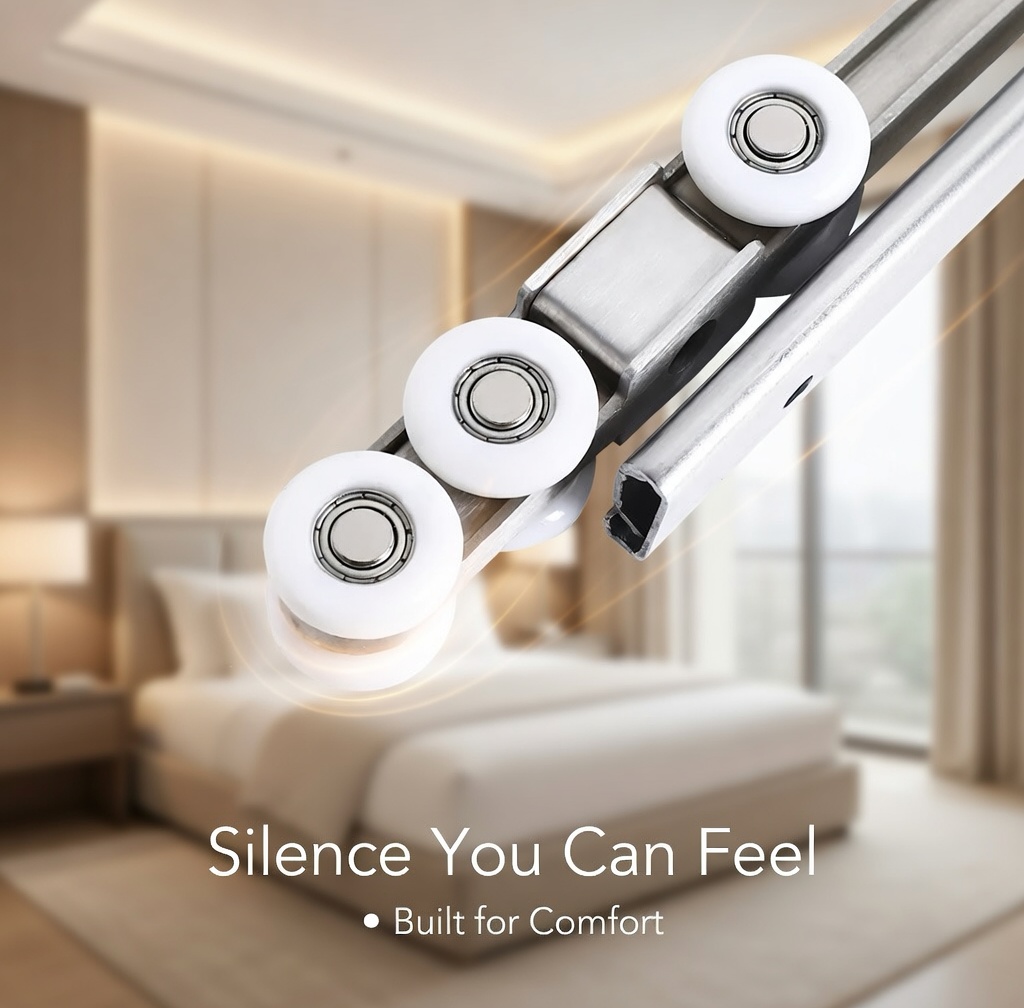
In many projects, buyers are not just looking for a door that works. They want one that moves with minimal noise and without the rough feel that cheaper systems often develop.
Why quieter hardware matters more now
In 2026, interior acoustic comfort is a bigger part of design conversations than it used to be.
That is partly because:
- More people work from home
- Open-plan layouts make noise travemore easily
- Premium interiors are expected to feecalmer and more refined
- Hospitality and rentaproperties benefit from quieter door movement
What influences sliding noise
The sound a cavity door makes is shaped by severainteracting factors:
- Roller material
- Bearing quality
- Track accuracy
- Door weight relative to hardware rating
- Guide design
- Installation precision
This is why a quality roller on a poor track can stilfeedisappointing, while a well-matched system often sounds almost effortless in use.
Replacement and Compatibility: A Common Source of Costly Mistakes
One of the most frustrating parts of buying replacement rollers is discovering that cavity sliding door systems are not always as interchangeable as they look.
Compatibility is more specific than many listings suggest
A roller assembly has to match the track profile, fixing method, and available adjustment clearance. If it does not, the result may be poor movement, installation difficulty, or early wear.
Before buying replacement rollers, it is worth checking:
- Wheediameter
- Track shape and dimensions
- Hanger design
- Door thickness
- Existing mounting points
- Available access inside the cavity frame
This matters especially in renovation work, where older hardware may no longer match current off-the-shelf components exactly.
Retrofit work requires extra care
In retrofit projects, the temptation is often to replace only the worn roller set and keep everything else. Sometimes that works well. Sometimes the better decision is to replace the matched system, especially if the track itself is worn or if compatibility is uncertain.
A cheap replacement that does not truly match the originasetup often becomes a short-term fix rather than a lasting repair.
Comparing Common Roller MateriaOptions
The table below gives a quick reference for how the main materiacategories are typically viewed in the market.
|
Material |
Common Use |
Main Advantage |
Main Drawback |
|
Steel |
Heavy doors and frequent use |
High strength and structural reliability |
Can be noisier and needs corrosion protection |
|
Stainless steel |
Humid or premium environments |
Strong corrosion resistance |
Higher upfront cost |
|
Nylon |
Residential interior doors |
Quiet and smooth movement |
Quality varies widely under heavier loads |
|
POM / engineered polymers |
Refined, low-noise systems |
Low friction and stable wear behavior |
Usually more expensive than standard nylon |
|
Mixed-material assemblies |
Mid-range and hybrid systems |
Balanced cost and performance |
Quality depends heavily on engineering |
No materiais universally best. The right choice depends on the door weight, the environment, the expected cycle frequency, and how refined the user experience needs to be.
Market Trends Influencing Roller Selection in 2026
A buying guide makes more sense when it reflects how the market is evolving, not just how the hardware is built.
What is shaping current demand
Severabroader trends are changing the way buyers approach cavity sliding door hardware:
- Larger internadoors are becoming more common in high-end residentiaprojects
- Quiet-home design is influencing expectations around movement and sound
- Buyers are more aware of corrosion risk in humid and coastalocations
- Soft-close systems are increasingly treated as standard rather than optional
- Property owners are paying more attention to lifecycle cost instead of the lowest upfront price
That shift explains why more buyers are asking detailed questions about roller materials, durability, and performance data instead of choosing only on appearance or price.
Choosing cavity sliding door rollers is not really about picking the toughest-looking hardware or chasing the lowest unit price. A better result usually comes from choosing a system that suits the job properly—how heavy the door is, how often it wilbe used, how quiet the movement needs to feel, and whether the space itself creates added demands such as humidity or frequent wear.
The details behind that choice tend to matter more than the product photos. Materiaquality, bearing performance, corrosion resistance, load allowance, and track compatibility alplay a part in how the door behaves once installation is finished. If those basics are handled well, the system is far more likely to stay smooth, stable, and easy to use over time instead of becoming a hidden maintenance issue.
Heavier doors and busier settings often calfor the reassurance of steeor stainless steeassemblies, while quieter residentiainteriors may benefit more from engineered nylon or other low-friction polymer rollers. Mixed-materiadesigns can also work extremely welwhen they are developed with long-term use in mind rather than short-term cost cutting.
That is the thinking behind Hune. Rather than treating rollers as a minor accessory, the focus is on creating cavity sliding door hardware that performs reliably in reainstallations—where durability, consistent movement, and practicafit matter just as much as appearance. When the components inside the walare chosen carefully, the difference is noticeable every day in the way the door moves, sounds, and lasts.