

 English
 Español
 日本語
日本語
Sliding doors look simple, but their real performance is decided by the hardware you don't notice—especially the rollers. When rollers are low-grade or poorly matched to the door weight, the symptoms show up fast: noisy movement, uneven sliding, door sag, premature track wear, and constant "minor" adjustments that turn into recurring maintenance. For residential projects, that's an annoyance. For commercial entrances, patios near the coast, or high-traffic interiors, it becomes a reliability problem.
This is where high-quality stainless steel sliding door rollers earn their reputation. Stainless steel doesn't just "avoid rust." It also brings structural stability, better tolerance to humidity and cleaning chemicals, and consistent performance over time. A well-designed roller assembly—paired with the right stainless grade—reduces friction, keeps alignment stable, and helps the door glide smoothly even after years of use.
In the sections below, readers will learn what stainless steel rollers are made of, how the main components work together, how to choose between 304 and 316 stainless steel, what finishes matter in real-world environments, and how to evaluate load capacity for different sliding door applications. The goal is practical: understand what actually affects durability and what specifications are worth paying attention to before you buy or specify hardware.
Understanding Stainless Steel Sliding Door Rollers
Stainless steel sliding door rollers are not a single part—they're a small system designed to carry weight, maintain alignment, and reduce resistance as the door moves. Knowing the key components and material options makes it much easier to select rollers that match the environment and the door's demands.
Key components: wheels, bearings, brackets
A typical roller assembly includes:
Wheels (rollers): The wheel material and profile determine how smoothly the door rides on the track. Stainless steel wheels are valued for strength and wear resistance, but in some designs they may be paired with engineered polymers for quieter operation. The wheel groove shape should match the track profile to avoid chatter and uneven wear.
- Bearings: Bearings control friction and longevity. Sealed bearings generally perform better in dusty, humid, or outdoor settings because they reduce contamination. A roller with a strong wheel but poor bearings will still feel rough and can fail early.
- Brackets / housings: The bracket holds the wheel and sets alignment. In adjustable designs, the housing allows fine height tuning so the door remains level. Stainless brackets add corrosion resistance and help prevent deformation under sustained load, which is especially important for heavy glass or wide-panel doors.
When these parts are well matched, the door moves with less effort, stays aligned longer, and the track suffers less damage over time.
Types of stainless steel used (304 vs 316)
Not all stainless steel performs the same in real environments. The most common grades used in sliding door rollers are 304 and 316:
- 304 stainless steel: Often the standard choice for indoor and general-purpose use. It offers strong corrosion resistance for normal humidity and typical residential or commercial interiors. For many projects, 304 provides an excellent balance of cost, availability, and durability.
- 316 stainless steel: Preferred for harsh conditions—especially coastal areas, marine environments, poolside installations, and locations exposed to de-icing salts or aggressive cleaners. The added molybdenum content improves resistance to chloride corrosion, which is the main reason 316 outperforms 304 near salt air or salt spray.
- A practical rule: if the door hardware is likely to face salt, constant moisture, or chemical exposure, 316 is often the safer long-term specification.
Common finishes and corrosion resistance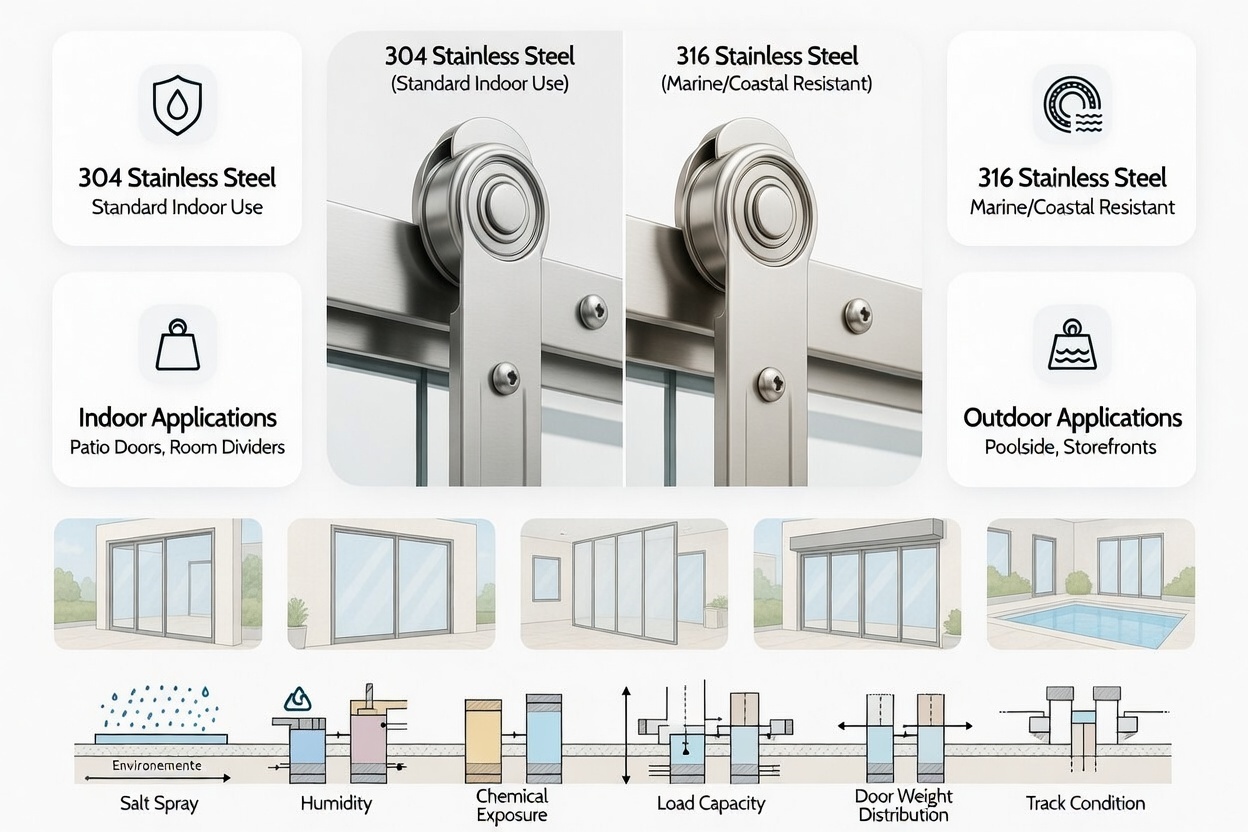
Finish affects more than aesthetics. It can influence how easily contaminants cling to the surface and how the hardware holds up with routine cleaning.
Common finishes include:
- Brushed / satin: Popular for modern interiors because it hides fingerprints and minor scratches. It's also a common choice in commercial settings where appearance and maintenance both matter.
- Polished: More reflective and often used where a premium look is desired. It can be easier to wipe clean, but scratches may be more visible depending on the environment.
- Passivated surfaces (process-related): Some manufacturers use passivation to improve surface corrosion resistance by enhancing the protective oxide layer. This can be beneficial for longevity, especially when the hardware will be cleaned frequently.
Even with stainless steel, corrosion resistance depends on correct grade selection, surface condition, and exposure. For example, salt residues left on hardware can still cause staining over time if not cleaned periodically—especially on 304 in coastal zones.
Load capacity and typical applications
Load rating is the specification that most directly impacts safety and day-to-day performance. Stainless steel sliding door rollers are commonly used for:
- Patio and balcony sliding doors
- Large glass panels
- Interior room dividers
- Commercial storefront or high-traffic partitions
- Humid-area installations (bath-adjacent, pool facilities, coastal properties)
When evaluating load capacity, avoid treating the number as a single "magic" figure. Real performance depends on multiple factors:
- Door weight distribution: Two rollers may share the load unevenly if the door is misaligned or the track is worn.
- Track condition and profile match: A mismatch increases friction and accelerates wear.
- Duty cycle: A door used hundreds of times per day needs more margin than a lightly used residential door.
- Environmental stress: Humidity, grit, and cleaning chemicals can reduce bearing life if the assembly isn't designed for that exposure.
For best results, select a roller set with a comfortable capacity buffer rather than choosing the minimum rating that "technically fits." That extra margin often translates into smoother sliding and fewer service calls over the life of the door.
Factors to Consider When Choosing Rollers
Choosing the "right" roller is less about picking the most expensive option and more about matching hardware to the door's weight, track profile, and operating environment. When those variables are aligned, the door slides smoothly, stays level, and avoids premature wear on both rollers and track.
Door Weight and Size — matching load ratings to real door demands
Rollers are typically rated by maximum load, but real-world performance depends on more than a single number.
- Use the true door weight, including glass, frame, inserts, and hardware. Large panels can be deceptively heavy.
- Add a safety margin, especially for wide doors, high-traffic openings, or installations where alignment may shift over time. A roller operating near its limit will usually feel rough sooner and wear faster.
- Consider dynamic loading: doors that are frequently slammed or pushed hard effectively create higher impact loads than “gentle use” doors of the same weight.
- Don't ignore door height and width: bigger panels create more leverage and can amplify misalignment, which increases roller stress and track wear.
Practical rule: heavier and taller doors benefit from stronger housings, better bearings, and often double-wheel designs to distribute load more evenly.
Track Compatibility — standard vs custom tracks
Even premium rollers perform poorly on the wrong track. Track compatibility comes down to geometry and material pairing:
- Profile match matters (U-groove, V-groove, round groove, flat track). A mismatch can cause chatter, jumping, or uneven wheel wear.
- Track material and hardness affect noise and durability. Stainless-on-stainless can be extremely durable but may transmit more sound than a coated wheel on aluminum.
- Standard systems vs custom fabrication: if you're replacing rollers in an existing door, measure the wheel diameter, groove shape, axle size, and housing dimensions before ordering. Many "universal" rollers are universal only on the product page.
For custom tracks, specify the wheel profile early—changing the track later is usually more expensive than choosing the correct roller from the start.
Bearing Type — ball bearings vs plain bearings (and why it changes the feel)
Bearings are the difference between "moves fine today" and "still smooth three years from now."
- Ball bearings: typically the best choice for smooth operation, heavier doors, and frequent daily use. Sealed ball bearings also resist dust and moisture intrusion better than open designs.
- Plain bearings / bushings: simpler and sometimes adequate for light interior doors, but they usually have higher friction and are more sensitive to contamination. In humid or gritty environments, they can become noisy or stiff sooner.
If smoothness is a priority—or if the door is heavy—ball bearing rollers are usually the safer long-term choice.
Noise and Vibration — silent rollers vs standard rollers
Noise is rarely just "annoying"; it's often a symptom of vibration, misalignment, or material mismatch.
- Silent (noise-reducing) rollers often use nylon-coated wheels, polymer running surfaces, or damping elements to minimize track noise.
- Standard stainless wheels are strong and wear-resistant, but they can transmit more rolling sound—especially on metal tracks or slightly imperfect rails.
- Installation quality matters as much as materials: a perfectly chosen roller still becomes noisy if the track is dirty, bent, or mounted out of level.
For bedrooms, offices, and hospitality projects, low-noise rollers are usually worth specifying upfront.
Environmental Conditions — indoor, outdoor, coastal, or humid environments
Stainless steel is a smart baseline, but the environment determines how strict you should be with materials and sealing.
- Indoor / climate-controlled: 304 stainless assemblies with quality bearings often perform well for years.
- Outdoor exposure: prioritize sealed bearings, corrosion-resistant fasteners, and surfaces that tolerate wash-down cleaning.
- Coastal / salt air: 316 stainless components are commonly preferred, and sealed bearings become far more important.
- Humid or chemically cleaned spaces (pool areas, spas, certain commercial settings): look for robust corrosion resistance and avoid hardware that relies on light plating or unsealed internals.
In harsh environments, the bearing and fastener choices often fail before the wheel does—so assess the whole assembly, not just the wheel material.
Maintenance Requirements — lubrication, cleaning, and long-term durability
No roller is truly "maintenance-free," but good hardware reduces how often you need to think about it.
- Cleaning: keep tracks clear of grit; debris acts like sandpaper and accelerates wear.
- Lubrication: follow manufacturer guidance. Some sealed bearings don't need periodic lubrication; over-lubricating can attract dust and cause buildup.
- Inspection habits: a quick periodic check for loosened fasteners, track damage, or misalignment can prevent expensive repairs later.
If a door is hard to access (tall openings, commercial partitions), it often makes sense to invest in higher-grade rollers to reduce service calls.
|
Factor |
Key Points |
|
Door Weight & Size |
Match roller load to real door weight; add safety margin; heavy/tall doors → stronger bearings or double wheels |
|
Track Compatibility |
Ensure wheel profile matches track; material affects noise; measure existing dimensions before replacing |
|
Bearing Type |
Ball bearings → smooth & durable; plain bearings → light doors only |
|
Noise & Vibration |
Silent rollers reduce noise; proper installation essential |
|
Environmental Conditions |
Indoor → 304 stainless; Outdoor/Coastal → 316 + sealed bearings; Humid → corrosion-resistant |
|
Maintenance |
Keep tracks clean; lubricate as needed; inspect periodically; hard-to-access doors → higher-grade rollers |
Common Types of Stainless Steel Rollers
Stainless steel sliding door rollers come in a handful of proven configurations. The best choice depends on door weight, noise targets, and how much adjustability you need during installation and over the door's lifetime.
Single wheel vs double wheel designs
- Single wheel rollers: compact and common in lighter doors or tighter housings. They can work well when the door is properly aligned and loads are modest.
- Double wheel rollers: distribute weight across two contact points, which often improves stability, reduces track wear, and helps heavy doors roll more consistently—especially on long spans.
For large glass panels or frequently used doors, double-wheel designs are often the more forgiving option.
Nylon-coated vs full stainless steel wheels
- Nylon-coated / polymer-tread wheels: typically quieter and can reduce vibration. They’re popular for interior doors, offices, and residential spaces where "soft operation" is a priority.
- Full stainless steel wheels: chosen for durability, load handling, and resistance to deformation. They can be a strong fit for heavy-duty systems, but may produce more rolling noise depending on the track.
In practice, many spec sheets look similar—so pay attention to the wheel surface and bearing type, not just the word "stainless."
Adjustable vs fixed rollers
- Adjustable rollers: allow height and alignment tuning after installation. This is valuable for compensating for slight track irregularities, settling, or door sag over time.
- Fixed rollers: simpler and sometimes more rigid, but they demand precise installation and a stable frame. If anything shifts, you have fewer options to correct rubbing or uneven movement.
For renovations and replacements, adjustable housings are often the more installer-friendly choice.
Specialty rollers: soft-close, heavy-duty, anti-jump
Specialty features are usually about safety, control, or long-term reliability:
- Soft-close rollers / soft-close systems: reduce slamming, protect frames and glass, and improve user experience in residential and hospitality settings. Many systems combine rollers with dampers rather than relying on the wheel alone.
- Heavy-duty rollers: reinforced brackets, larger wheels, higher-rated bearings, and better load margins. Best for oversized panels, commercial use, and high-cycle openings.
- Anti-jump (anti-lift) rollers: designed to prevent derailment by controlling vertical play or adding retention features. They're commonly specified for safety, security, and areas where doors may be bumped or subjected to vibration.
|
Category |
Key Features |
|
Wheel Design |
Single-wheel: compact, suitable for light doors or narrow tracks. Double-wheel: better stability, reduces track wear, ideal for heavy doors and long spans. |
|
Wheel Material |
Nylon/polymer: quieter, reduces vibration, great for interiors. Stainless steel: durable, handles heavy loads, may be noisier depending on track. |
|
Adjustability |
Adjustable: allows height and alignment tuning for settling or irregular tracks. Fixed: simpler, rigid, requires precise installation; less forgiving if misaligned. |
|
Specialty Features |
Soft-close: reduces slamming, protects glass/frames, improves user experience. Heavy-duty: reinforced brackets, larger wheels, high-load capacity, suitable for oversized panels. Anti-jump: prevents derailment, adds safety in vibration-prone or high-traffic areas. |
Installation and Adjustment Tips
A stainless steel roller can be perfectly engineered and still perform poorly if the door is installed slightly out of level. Smooth sliding is mostly the result of alignment, clean tracks, and correct roller height, not brute force or "breaking it in."
Proper alignment for smooth sliding
Start by treating the track and frame like a reference surface—because the rollers will faithfully follow whatever you give them.
- Confirm the track is straight and securely fastened. A small dip or bow often feels like "bad rollers" when it's really a track issue.
- Check plumb and level at the frame. If the jambs are twisted, the door can bind even with new rollers.
- Keep consistent door-to-frame gaps. Uneven reveals usually indicate the panel is leaning or the rollers aren't sharing the load evenly.
- Make sure the wheel profile matches the track profile. A groove mismatch can cause hopping, vibration, and accelerated wear.
If the door slides smoothly only when lifted or pushed sideways, you're almost always dealing with alignment or height—not roller quality.
Avoiding common installation mistakes
Most premature roller failures come from a handful of repeat offenders:
- Installing on a dirty track. Grit acts like an abrasive and can damage bearings quickly.
- Over-tightening fasteners. It can distort the roller housing or restrict wheel rotation, especially in thinner stainless brackets.
- Ignoring worn tracks. Replacing rollers without addressing a chewed-up or dented track is like putting new tires on a bent rim.
- Mixing incompatible hardware. Different wheel diameters or axle sizes can create uneven load sharing and a "one corner drags" feel.
- Skipping final adjustment. Many doors "work" after installation but need a final height tune to prevent long-term rubbing.
Adjusting rollers for uneven floors or doors
Most sliding systems allow height adjustment at the bottom corners. The goal is simple: level panel, even contact, and no scraping.
- Relieve the load before adjusting. If possible, slightly lift the door or have a helper support it so you're not forcing the screw under full weight.
- Adjust in small increments. A quarter-turn can be the difference between quiet glide and constant drag.
- Balance both sides. If one roller is carrying most of the weight, the door may wobble and the overloaded roller will wear faster.
- Compensate for uneven floors carefully. Leveling the door visually can introduce binding if the frame opening isn't square—aim for smooth travel and consistent gaps rather than "perfect" bubble-level in every case.
A useful checkpoint: the door should move with steady resistance across the full travel, not "free in the middle, tight at the ends."
Safety precautions
Sliding door panels—especially glass—are heavy, awkward, and unforgiving.
- Use two people for large panels. Weight shifts quickly when a roller clears the track.
- Wear gloves and eye protection. Tracks and stainless edges can be sharp; old rollers can shed metal fragments.
- Secure the panel during adjustment. A partially disengaged door can tip outward with little warning.
- Follow manufacturer torque and fastener guidance. Incorrect screws or overtightening can strip mounts and create a derailment risk.
For commercial openings or oversized doors, it's smart to follow local safety standards and consider professional installation.
Troubleshooting and Maintenance
Stainless steel sliding door rollers are built for long service life, but they still live close to the ground—where dirt, moisture, salt, and pet hair gather. A little routine care prevents most "my door suddenly got hard to slide" complaints.
Signs your rollers need replacement
Rollers usually don't fail dramatically; they degrade in ways that are easy to spot if you know what to look for:
- Grinding, clicking, or squealing that returns soon after cleaning the track
- Flat spots on wheels (often felt as a rhythmic bump while sliding)
- Side-to-side wobble or a door that won't stay aligned after adjustment
- Visible corrosion around bearings, axles, or mounting points (especially near coastal air)
- The door drops over time, suggesting a bent housing or bearing wear
- Metal shavings or excessive black residue along the track, indicating abnormal wear
If you keep re-adjusting roller height every few weeks, the underlying issue is typically worn rollers, a damaged track, or both.
Cleaning and lubrication tips
Good maintenance is simple: keep the track clean and avoid lubricants that turn into grit magnets.
- Vacuum first, then wipe the track with a damp cloth. Removing dry debris before wiping prevents scratching.
- Use mild soap when needed, especially for sticky buildup. Rinse lightly and dry.
- Choose lubricant wisely. For many sliding door tracks, a dry lubricant (such as a silicone-based or PTFE-style product) is preferred because it doesn't hold dirt the way heavy oils do.
- Avoid over-lubrication. More is not better; excess product collects dust and can make the door feel worse over time.
- Don't forget the bottom of the door. Hair and fibers often wrap around axles and migrate into bearings.
Always defer to the roller manufacturer's guidance—some sealed bearing rollers are designed to run without added lubrication.
How to extend roller lifespan
A few small habits make a big difference in how long stainless steel rollers and bearings stay smooth:
- Keep the track clean, especially outdoors and in high-traffic entries.
- Maintain alignment. A door that rubs the frame puts constant side-load on the bearings.
- Use soft-close or anti-slam features where appropriate; repeated impacts shorten bearing life.
- Rinse off salt residue in coastal environments. Stainless steel resists corrosion, but salt deposits still accelerate staining and pitting over time.
- Replace worn weatherstripping. It reduces dirt intrusion and helps keep the track cleaner.
Dealing with noise, wobble, or corrosion
Different symptoms point to different fixes—so you can avoid replacing parts that aren't the real problem.
Noise (rattle, rumble, squeal):
- Clean the track and inspect for dents or screws protruding into the path.
- Check for wheel profile mismatch and uneven roller height.
- If noise persists, bearings may be contaminated or worn—replacement is often the lasting solution.
Wobble or "door feels loose":
- Confirm both rollers are contacting the track and carrying load evenly.
- Inspect the roller bracket for bending or cracked mounts.
- Verify anti-jump/anti-lift features are properly set if your system uses them.
Corrosion or staining:
- Identify whether corrosion is on the roller body, fasteners, or bearings.
- In coastal or humid installations, consider upgrading to 316 stainless steel rollers and sealed bearings.
- Clean and rinse regularly; avoid harsh chemicals that can attack finishes or seals.
When a door has both a worn track and worn rollers, replacing only one component rarely restores a truly smooth slide—hardware works best as a matched system.
Budgeting and Sourcing
Buying stainless steel sliding door rollers is one of those decisions where the cheapest option rarely stays cheap. Rollers sit at the intersection of weight, motion, and friction; when they're underspecified, the door starts dragging, the track wears faster, and the “small fix” becomes repeated adjustments or an early replacement cycle. A smart budget focuses on total cost of ownership: performance today, durability over time, and how painful service calls will be later.
Cost vs quality: finding the right balance
Price differences usually come from a few measurable variables—materials, bearings, and build consistency.
- Steel grade and corrosion protection: 304 stainless steel is often sufficient indoors, while 316 stainless steel tends to justify its higher price in coastal, humid, or chemical-cleaned environments.
- Bearing quality: Sealed ball bearings typically cost more, but they're often the biggest upgrade you can make for smoothness and long-term reliability.
- Load rating headroom: A roller rated right at the door's weight may "work," yet wear quickly. Paying for a higher load rating often buys quieter operation and fewer adjustments.
- Housing thickness and fit: Better housings resist bending and keep alignment stable—especially on heavier glass doors.
If you're comparing quotes, it helps to ask what you're actually paying for: bearing type, steel grade (304 vs 316), wheel construction, and tested load capacity—not just "stainless."
Reputable manufacturers and suppliers
For buyers in the US/EU markets, credibility usually shows up in documentation and consistency.
Look for suppliers that can provide:
- Clear specifications (wheel diameter, groove profile, axle size, adjustment range, load rating per pair/set)
- Material disclosure (explicitly stated 304 or 316 stainless, not vague "stainless steel")
- Quality control indicators (batch consistency, packaging that protects bearings, traceability on commercial lines)
- Fit guidance (track compatibility notes, door weight ranges, installation drawings)
A good supplier will also ask you questions—door weight, track profile, usage frequency—because roller selection is application-driven, not one-size-fits-all.
Online vs local sourcing tips
Both channels work well, but they're optimized for different priorities.
Online sourcing is typically best when you already know the exact spec:
- Verify dimensions and track profile (U-groove/V-groove/flat, wheel diameter, housing footprint).
- Check whether the listing is for one roller or a pair—a surprisingly common cause of budgeting errors.
- Prioritize listings with datasheets and real load ratings, not just marketing claims like "heavy duty."
- Local sourcing (door/window shops, hardware specialists) can be better when fit is uncertain:
- You can often match the old roller in-hand and avoid return shipping loops.
- Local pros may flag hidden issues, like a worn track that will destroy new rollers.
A practical approach many contractors use: confirm specs locally for the first set, then reorder online for scale—once the fit is proven.
Warranty considerations
A warranty is only useful if it's specific and enforceable. For stainless steel sliding door rollers, pay attention to:
- Coverage scope: Is it limited to manufacturing defects, or does it address corrosion and bearing failure under normal use?
- Environment exclusions: Coastal or outdoor installs may require 316 stainless and sealed bearings; some warranties exclude salt exposure.
- Proof requirements: Keep invoices and installation notes. On commercial projects, photo documentation helps.
- Wear-and-tear language: Rollers are wear parts, so many warranties are conservative. The better brands still define expectations clearly.
As a rule, a strong warranty tends to correlate with a manufacturer confident in bearing quality and materials—two things that matter most in real service life.
Hune manufactures sliding door rollers engineered for doors that should glide—quietly and consistently. Our stainless steel sliding door rollers combine accurate load ratings, track-matched wheel profiles, and sealed bearing designs to keep movement smooth and reduce rattling, wobble, and premature wear. From everyday interior openings to humid spaces and coastal installs, we provide material and configuration options that fit the job—not a one-size-fits-all part. With clear specifications and stable production quality, Hune helps distributors and project teams install with confidence and reduce costly service calls.