

 English
 Español
 日本語
日本語A sliding door can stay in daily use for years without attracting much attention. The panel moves along its track, the rollers support the weight, and the whole assembly does its job quietly in the background. Then a faint clicking sound appears. A few weeks later, the movement may include a scrape, rumble, or rough rolling noise. At that point, the sound is easy to notice because it happens every time the door moves.
The noise is rarely caused by one part alone. A sliding door roller works as part of a small mechanical system that includes the wheel, bearing, axle, housing, door frame, and running track. Changes in any of these areas can affect how the assembly moves and how much vibration reaches the surrounding structure.
For homeowners, installers, distributors, and door manufacturers, understanding where the sound comes from can make diagnosis much easier. A noisy roller does not always mean that the wheel itself has failed, and replacing a wheel without checking the track or mounting condition may leave the original cause unresolved.
The Sound Usually Starts With A Change In Contact
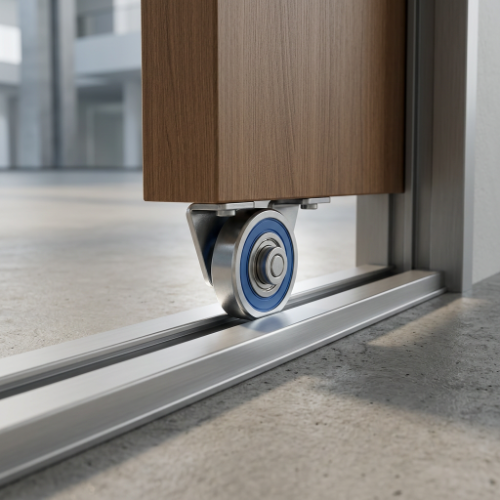
A roller is designed to roll along a surface rather than slide across it. When the wheel rotates evenly and the contact between the wheel and track remains stable, movement can be relatively quiet.
Noise tends to appear when that relationship changes.
The wheel may no longer contact the track evenly. A bearing may develop additional resistance. Small particles may enter the running path. The door can become slightly misaligned and place more force on one side of the assembly.
These changes are often gradual, which explains why users may not notice the beginning of the problem.
A door that was once quiet might first produce a light clicking sound. Later, the same movement could create a rougher rolling noise. The change in sound is useful because it can provide an early indication that something inside the sliding mechanism deserves attention.
What Changes Inside The Assembly?
Several conditions can affect rolling behavior:
- The wheel surface changes shape.
- The bearing becomes less free-moving.
- The track develops contamination or surface damage.
- The door load becomes uneven.
- The roller housing shifts from its intended position.
- Moisture affects metal components.
- The wheel and track no longer make consistent contact.
These conditions do not always occur separately. In an older sliding door, several may develop at the same time.
Why Does A Sliding Door Roller Get Louder With Age?
Age itself is not the mechanical cause of noise. What changes over time is the condition of the parts and the environment around them.
Every opening and closing cycle creates another period of contact between the wheel and track. The bearing rotates, the wheel carries the door load, and the track receives repeated rolling contact. Small particles can also enter the system during those cycles.
The result is a gradual change in the mechanical surfaces.
A roller may still look acceptable from outside while the bearing or wheel contact surface has already changed.
Repeated Movement Adds Up
Consider a door used several times each day.
The roller does not simply move from one end of the track to the other. It repeatedly accelerates, rolls, changes direction, and stops. Each movement adds another cycle to the mechanical system.
Over time, this repeated contact can influence:
- Wheel surface condition
- Bearing rotation
- Track smoothness
- Mounting stability
- Door alignment
This is why a noise that seems to appear suddenly may actually represent a condition that has been developing gradually.
The Bearing Can Change The Sound
Inside many roller assemblies, the bearing plays an important role in allowing the wheel to rotate around its mounting point.
When the bearing rotates smoothly, the wheel can follow the track with relatively little resistance. If the internal surfaces become contaminated, worn, corroded, or otherwise irregular, the rotation may become less consistent.
The resulting sound can vary.
A light clicking noise may indicate intermittent contact or internal movement. A rough grinding sound can suggest increased friction. A repeating rumble may occur when the wheel or bearing rotates through a particular position.
These sounds are clues rather than definitive diagnoses.
Why The Bearing Is Easy To Overlook
The wheel is visible, while the bearing is usually hidden inside the assembly.
A quick visual inspection may therefore show nothing unusual. The outer wheel can still appear round and intact even when the bearing is no longer moving as it should.
For manufacturers, this is one reason the bearing should be considered as part of the complete roller design rather than treated as an unrelated internal component.
Could The Wheel Material Affect Noise?
Yes, wheel material can influence the sound produced during rolling contact.
Different materials behave differently when they meet a track surface. A polymer wheel and a metal wheel may produce noticeably different acoustic characteristics even when installed in similar door systems.
The interaction depends on more than the wheel itself. The track material, wheel profile, load, surface condition, and mounting arrangement also matter.
For example, a relatively rigid wheel running against a rigid track can transfer vibration differently from a polymer wheel operating against a metal running surface.
Material Selection Is A System Decision
Manufacturers choosing a wheel material should consider the complete application rather than selecting a material based on a single characteristic.
| Consideration | Why It Matters |
|---|---|
| Wheel material | Influences contact and vibration behavior |
| Track material | Changes the mating surface |
| Door load | Affects wheel deformation and contact pressure |
| Operating environment | Can influence material condition |
| Movement frequency | Determines repeated contact cycles |
| Bearing structure | Influences rotational behavior |
| Wheel profile | Determines how the track is contacted |
This is particularly relevant when developing roller assemblies for different door constructions.
A component intended for a lightweight interior door may have different requirements from one used in a larger exterior panel.
When Dirt Becomes Part Of The Problem
Sliding door tracks are naturally exposed to particles.
Dust, sand, hair, small fibers, construction residue, and other debris can enter the running area. Once particles settle around the wheel path, they can interfere with normal rolling.
A small amount may not create an obvious problem. Larger accumulation can change the contact surface and produce intermittent sounds.
Why A Dirty Track Can Sound Like A Bad Roller
Imagine a wheel traveling over a small particle.
The wheel may rise slightly, move over it, and return to the track. That change can create a small impact. If the same type of contamination is spread through the running path, the user may hear repeated clicking or rough rolling.
This makes diagnosis slightly tricky.
The roller may be functioning reasonably well, but the environment around it is preventing normal operation.
That is why checking the track should usually be part of any noise investigation.
Track Condition Deserves Equal Attention
A sliding door roller cannot operate independently from its running surface.
Even a properly constructed wheel can become noisy if the track has dents, grooves, contamination, corrosion, or other surface changes.
A damaged track can also affect the wheel in a repeating pattern. If the same damaged section is encountered during every opening and closing cycle, the user may hear a predictable noise at the same point in the travel path.
A Useful Way To Compare The Symptoms
| Observation | Area Worth Checking |
|---|---|
| Noise occurs throughout travel | Wheel, bearing, or general alignment |
| Noise occurs at one location | Track surface or localized debris |
| Repeating click during movement | Wheel profile or bearing rotation |
| Scraping near one edge | Alignment or track contact |
| Rattle without heavy resistance | Mounting or vibration |
| Rough movement with noise | Wheel, bearing, track, or contamination |
This does not replace a physical inspection, but it can help narrow down where to look.
What Happens When The Door Is Slightly Misaligned?
A sliding door depends on a reasonably balanced relationship between the panel, rollers, and track.
If the panel shifts out of alignment, the rollers may not contact the running surface in the same way they did originally. One side can receive more force while another side receives less.
That uneven condition can create additional friction and vibration.
A door may also begin rubbing against another part of the frame. In that situation, the noise may not actually originate from the roller.
Alignment Problems Can Create A False Diagnosis
This is an important distinction for installers and manufacturers.
A customer may report that the sliding door rollers are noisy, but the actual cause could be the door frame, track, adjustment position, or mounting structure.
Before replacing a roller, it is useful to determine whether the wheel is actually responsible for the sound.
If the noise changes significantly when the door position is adjusted, the alignment deserves further attention.
Why Loose Hardware Can Create Unexpected Noise
Not every roller noise comes from rolling contact.
The roller assembly is connected to the door through a mounting structure. If a fastener becomes loose or a bracket no longer holds the assembly firmly, small movements can occur during operation.
Those movements may create a rattle or clicking sound.
The sound can be amplified by the door panel itself because larger panels can act as sound-transmitting surfaces.
Vibration Can Travel Through The Door
A small mechanical vibration at the roller can travel into:
- The roller housing
- The door frame
- The track
- Nearby panels
- Fasteners and brackets
As a result, the sound heard by the user may seem louder than the original movement inside the roller.
This is one reason acoustic behavior should be considered during product development rather than only after installation.
Moisture Can Change The Mechanical Condition
Exterior sliding doors and doors installed in humid areas can experience moisture exposure.
Water itself does not automatically make a roller noisy. The concern is what repeated moisture exposure can do to susceptible metal surfaces, bearings, fasteners, and surrounding components.
Corrosion can change the smoothness of a contact surface. It can also interfere with adjustment hardware and bearing movement.
In some environments, condensation may be enough to create a recurring moisture condition even when the door is not directly exposed to rain.
Outdoor Doors Need A Different Design Perspective
For an outdoor application, manufacturers may need to consider:
- Moisture exposure
- Drainage
- Dust accumulation
- Temperature changes
- Salt-containing air
- Material compatibility
- Bearing protection
A roller intended for an indoor cabinet door does not necessarily face the same conditions as one used in an exterior patio door.
The application should therefore be defined before the roller construction is selected.
Why Flat Spots Can Produce A Repeating Noise
A wheel is expected to maintain a consistent rolling profile.
If a section of the wheel becomes flattened, the wheel can behave differently each time that section reaches the track.
The result may feel like a small bump during movement.
The sound can also become rhythmic because the same area of the wheel returns to the contact position after each rotation.
The Pattern Can Be More Useful Than The Volume
A loud noise naturally attracts attention, but the pattern of the sound may provide more information.
For example:
One sound at a specific location:
The track may have a localized issue.
A repeated sound during every wheel rotation:
The wheel surface or bearing deserves inspection.
A continuous rough sound:
Contamination, bearing condition, or contact pressure may be involved.
A loose rattle:
The mounting structure may need attention.
Again, these are diagnostic clues, not automatic conclusions.
Does Door Weight Influence Roller Noise?
The roller supports the moving door panel, so the load carried by the assembly matters.
A roller selected for one type of door may not be appropriate for a substantially different construction.
Door weight can be influenced by the panel material, glazing, frame construction, decorative elements, and overall size.
When the load is unevenly distributed, one roller may also carry more force than another.
Uneven Loading Changes Contact
Imagine a two-roller system where one side of the door sits lower.
The roller on that side may experience a different contact condition from the opposite wheel. The result can be uneven wear and a change in movement behavior.
For manufacturers, this makes load distribution an important part of roller selection.
It is not simply a question of whether a wheel can physically fit into the door.
Why Does The Noise Sometimes Come And Go?
Intermittent noise can be particularly confusing.
A roller may sound quiet when the door moves in one direction and noisy when it returns. The sound may also appear only when the panel is pushed from a particular position.
This can happen because the forces acting on the assembly change as the door moves.
Track irregularities, uneven loading, wheel orientation, bearing condition, and frame alignment can all influence the contact relationship.
Temperature Can Also Change The Feel
Materials respond to temperature changes in different ways.
A door exposed to changing environmental conditions may therefore behave slightly differently at different times of the day or during different seasons.
This does not mean temperature is always the cause of noise. It simply illustrates why a mechanical system can behave differently under changing conditions.
A Practical Inspection Approach
When a sliding door becomes noisy, replacing components immediately is not always the most efficient approach.
A basic inspection can start with the surrounding system.
Start With The Track
Look for visible debris, surface damage, corrosion, or anything that could interfere with wheel movement.
A clean running surface makes the next inspection easier.
Then Observe The Door Movement
Move the panel slowly and pay attention to when the sound appears.
Does it occur throughout the travel path?
Does it happen only near one end?
Does the door feel different when moving in the opposite direction?
These observations can help separate a wheel issue from a track or alignment issue.
Inspect The Roller Assembly
If the design allows access, check the wheel surface and mounting condition.
Look for:
- Cracks
- Flattened areas
- Uneven wear
- Visible contamination
- Wheel wobble
- Bearing irregularities
- Loose mounting components
A roller that looks visibly damaged deserves further attention.
When Is Replacement More Practical?
Cleaning and adjustment can address some noise conditions, but they cannot restore a mechanically damaged wheel or bearing.
Replacement may be appropriate when:
- The wheel has visible deformation.
- The bearing no longer rotates smoothly.
- The assembly has excessive play.
- Noise continues after the track condition has been addressed.
- The wheel no longer maintains stable contact.
- The mounting structure is damaged.
The replacement should match the actual door system.
Simply choosing a wheel because it looks similar may create another mismatch.
What Should Manufacturers Consider When Developing Sliding Door Rollers?
For manufacturers, noise control begins during component design.
The wheel profile, material, bearing structure, mounting method, track relationship, and operating environment all influence the final behavior.
Wheel Geometry
The wheel should be compatible with the intended running surface.
A mismatch can create uneven contact and unnecessary vibration.
Bearing Arrangement
The bearing should suit the movement pattern and surrounding environment.
The expected operating conditions should be considered alongside the wheel structure.
Material Combination
The wheel and track form a contact pair.
Selecting them independently can produce unexpected acoustic or wear behavior.
Mounting Structure
The housing needs to keep the wheel in the intended position while allowing the assembly to function through the full movement range.
Environmental Conditions
Indoor, outdoor, humid, dusty, and coastal applications can create different requirements.
The same roller construction may not be appropriate for every environment.
A Simple Sourcing Checklist
For distributors and door manufacturers evaluating roller assemblies, the following checklist can make technical discussions more productive.
| Question | Why It Matters |
|---|---|
| What type of door uses the roller? | Defines the application |
| What is the running surface? | Determines wheel compatibility |
| What is the wheel material? | Influences contact behavior |
| What bearing arrangement is used? | Affects rotation |
| How is the roller mounted? | Determines installation compatibility |
| Is the application indoor or outdoor? | Helps define environmental requirements |
| How frequently will the door operate? | Indicates expected movement cycles |
| Is the load evenly distributed? | Helps prevent uneven wheel loading |
| Is customization required? | Determines development requirements |
This kind of information is useful when discussing samples, drawings, or replacement components with a roller manufacturer.
Noise Is Often A Clue, Not The Whole Problem
A noisy sliding door roller is easy to blame on the wheel because the sound seems to come from the bottom of the panel.
The actual cause can be more complicated.
A bearing may be changing the way the wheel rotates. A track may contain debris. A door may be slightly out of alignment. A mounting bracket may have loosened. The wheel material may no longer match the operating conditions. Moisture may have affected internal metal parts.
That is why the most useful approach is to look at the entire movement system.
The Roller And Track Work As A Pair
The wheel cannot be separated from the surface beneath it.
A good roller installed on a damaged track can still produce noise. Likewise, a clean track cannot compensate for a wheel with a damaged bearing or deformed surface.
The two components need to work together.
This principle is particularly important for manufacturers because a roller should be evaluated within the intended assembly rather than only as an individual component.
How Can Manufacturers Create A More Consistent Roller Solution?
A practical development process usually begins with the application.
Instead of starting with a generic wheel and trying to fit it into the system afterward, manufacturers can define the door construction, running surface, load condition, environment, movement pattern, and available installation space first.
Those details provide a foundation for selecting the wheel profile, material, bearing arrangement, and mounting structure.
For customized projects, drawings, samples, sketches, or photographs of the existing assembly can help communicate the mechanical requirements more clearly.
This approach is especially useful when a replacement roller needs to fit an existing housing or when a new door system requires a particular wheel geometry.
The Quietness Of A Sliding Door Starts With The Mechanical Details
Sliding door rollers are small components, but their working conditions are not simple.
They carry load, rotate repeatedly, interact with a track, and operate in environments where dust, moisture, temperature changes, and alignment changes can occur. Over time, these factors can alter the way the wheel and bearing behave.
That is why noise should not automatically be treated as a single-part failure.
A clicking sound may point toward a repeating wheel or bearing condition. A scrape may suggest contact or alignment. A rough rolling sound may be associated with contamination or internal resistance. A rattle may come from the mounting structure rather than the wheel itself.
For homeowners and installers, identifying the pattern can make inspection more focused. For manufacturers and distributors, understanding these relationships can help when selecting or developing roller assemblies for different door applications.
The practical lesson is simple: a sliding door roller works as part of a complete mechanical system. Wheel geometry, material, bearing support, track condition, alignment, load distribution, and environmental exposure all contribute to how that system behaves over time.
When those factors are considered together during design and sourcing, manufacturers can develop roller assemblies that are better matched to the intended door application, while users and installers have a clearer way to understand where unexpected noise may be coming from.