

 English
 Español
 日本語
日本語Open a sliding door made in recent years, and there is a reasonable chance the wheel inside is molded plastic rather than machined metal. This is not a marketing trend dressed up as innovation—it reflects a genuine shift in what injection molding can offer over traditional metal fabrication for this specific part.
The Manufacturing Difference: Removing Material vs. Forming It
Two Fundamentally Different Processes
Metal rollers are typically produced by machining—cutting, turning, or stamping a wheel shape out of solid metal stock. Injection molded rollers are produced by forming molten resin inside a precision mold cavity shaped exactly like the finished part.
- Machining is subtractive: material is removed step by step until the final shape remains.
- Molding is formative: the final shape is created directly, in one cycle, from raw resin.
Why This Distinction Matters at Production Scale
- Machining time scales with part count—every unit requires its own cutting cycle.
- Molding cycle times are typically measured in seconds once a mold exists, largely independent of design complexity.
- Tool wear in machining gradually shifts dimensions across a long production run, while a stable mold produces dimensionally consistent parts from the first unit to the last.
What This Means for Bulk Buyers
For a handful of custom parts, this difference barely matters. For the order volumes typical of sliding door and window hardware—often in the thousands of units—the cumulative time and consistency difference becomes a real factor in cost, lead time, and quality control.
Groove and Flange Geometry: Built Into the Mold, Not Added Afterward
Why Groove Shape Is the Roller's Most Critical Feature
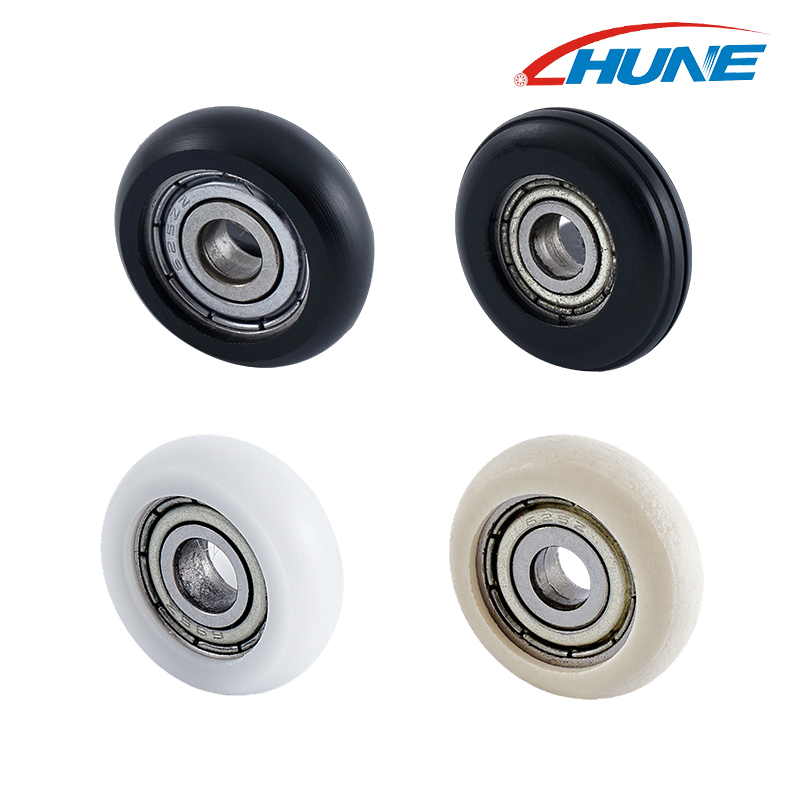
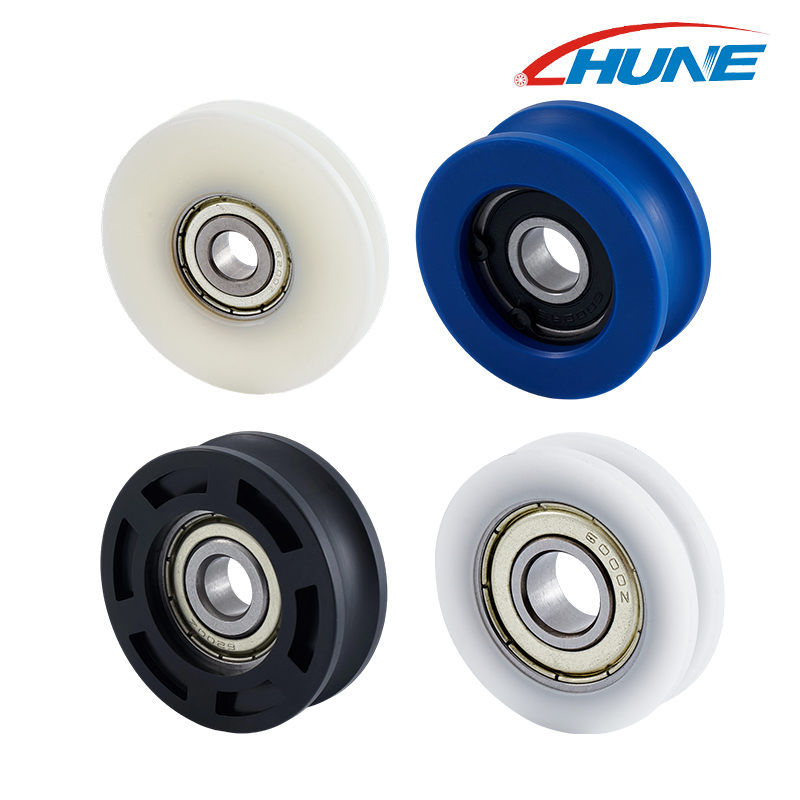
A sliding door roller needs a groove—typically U-shaped or V-shaped—that seats correctly onto its rail. The groove profile determines:
- How the wheel tracks
- How evenly load is distributed
- How much lateral play exists during operation
Machining a Groove vs. Molding a Groove
In metal manufacturing, the groove is a separate machining step performed after the basic wheel shape is formed, adding time and cost as the profile becomes more detailed.
In injection molding, the groove geometry is designed directly into the mold cavity. The wheel comes out already shaped correctly, with no additional cutting step.
The Role of the Flange
Many rollers include a flange—a raised lip on one or both sides of the wheel—that provides extra lateral guidance and helps prevent the wheel from slipping sideways off the rail.
- Flanged designs offer more stability on tracks with side-load risk or slight misalignment.
- Groove-only designs offer lower rolling friction where the track is straight and well maintained.
Both flange and groove-only profiles are straightforward to produce through mold design, without the added machining complexity that a flanged metal wheel would typically require.
Custom Profiles Without Custom Machining Setups
Once a mold exists for a specific groove or flange profile, producing that shape does not add meaningful cost compared to a simpler design.
This is a large part of why custom groove profiles—matched to a specific rail diameter or angle—have become more accessible to OEM buyers than they were under a purely machining-based production model.
It is worth being precise here: a new mold still requires upfront design and tooling investment. What changes is the ongoing cost of producing that custom shape once tooling exists—it becomes part of the standard molding cycle, not a specialized operation repeated for every batch.
Material Behavior: A Genuinely Different Set of Trade-Offs
What Metal Offers, and Where It Is Limited
Metal rollers offer high raw strength and are well suited to very heavy loads. Their main limitation is that performance is largely fixed by the metal grade chosen—hardness, corrosion resistance, and weight all move together rather than being independently adjustable.
What Engineering Plastics Offer Instead
Injection molded rollers are commonly produced from POM (acetal) or reinforced nylon, materials with well-documented properties in plastics engineering.
| Design Requirement | How the Material Responds |
|---|---|
| Corrosion resistance in humid or coastal settings | Engineering plastics do not corrode, removing a failure mode metal must otherwise manage through coating or plating. |
| Low-friction operation | POM has naturally low surface friction, reducing long-term reliance on grease. |
| Vibration and noise dampening | Plastics generally transmit vibration less directly than rigid metal-on-metal contact. |
| Added stiffness without added weight | Reinforced (glass-fiber) nylon increases load tolerance without matching the weight of steel. |
An Important Caveat
None of these properties make plastic universally "better" than metal. They represent a different set of trade-offs. The right choice depends on matching the material to the actual load, environment, and duty cycle of the specific application—not defaulting to one material out of habit.
Bearing vs. No Bearing: A Design Decision, Not a Material Default
The Common Misconception
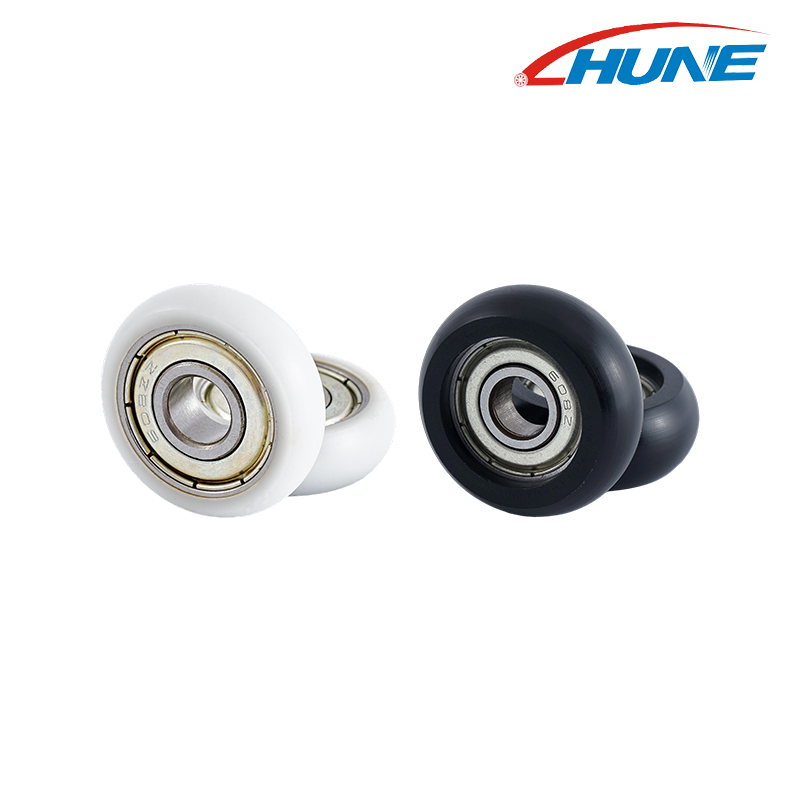
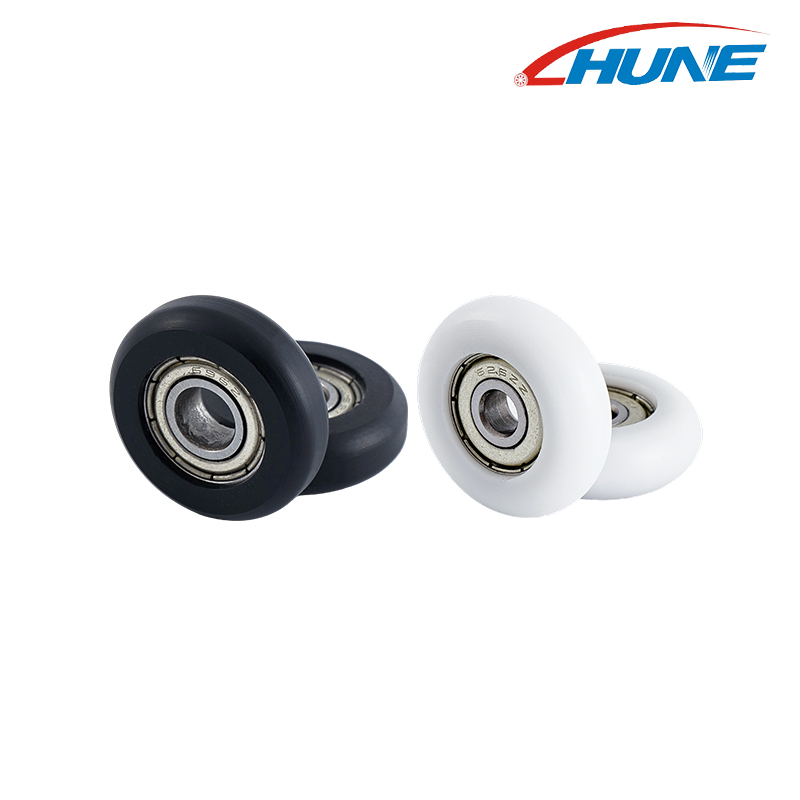
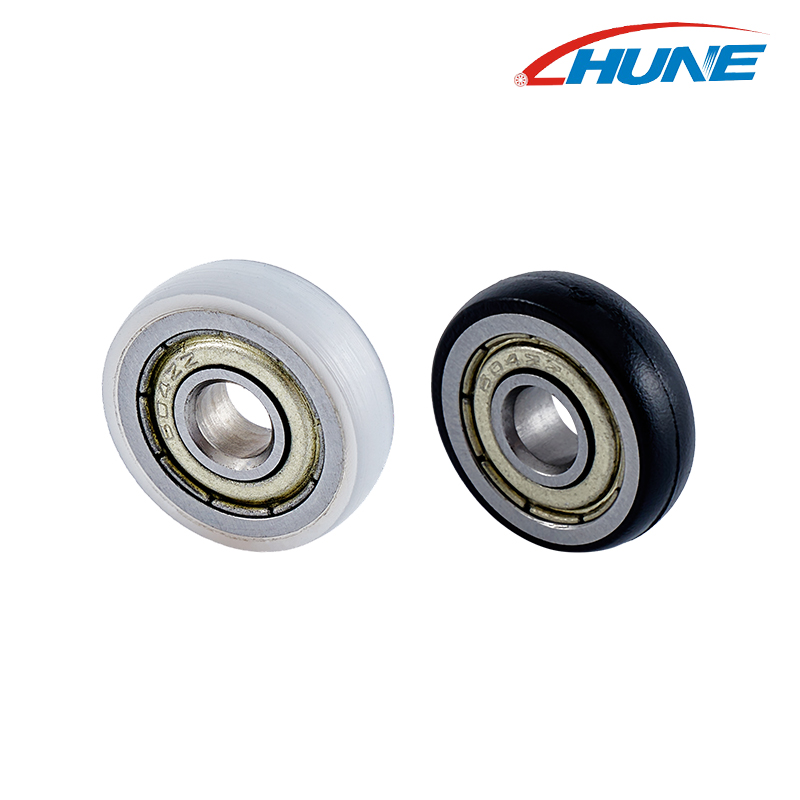
It is easy to assume "plastic roller" automatically means "no bearing inside," but in practice, whether a roller uses a rolling-element bearing is a separate engineering decision from the material choice.
When a Solid Molded Wheel Makes Sense
- Lighter doors, such as cabinets, closets, and small interior partitions
- Moderate daily cycle counts rather than constant heavy use
- Priorities around reducing part count and assembly complexity
When a Bearing Is Still the Right Call
- Heavier doors, such as exterior sliding glass panels
- High-cycle, high-traffic commercial applications
- Situations where reduced rolling friction under sustained load is a functional requirement rather than a bonus
Why This Distinction Matters for Buyers
Treating "bearing vs. no bearing" as a load-and-cycle decision—rather than a cost shortcut—is what separates a well-specified molded roller from a poorly matched one.
A bearing-free wheel used correctly in a light-duty application performs reliably. The same wheel used on a heavy, high-cycle door would likely underperform regardless of how well it was molded.
Surface Finish and Mold Quality: The Detail That Is Easy to Overlook
Why Surface Consistency Matters as Much as Shape
Even a correctly shaped roller can generate noise, vibration, or premature wear if the contact surface finish is inconsistent. In injection molding, surface finish is determined largely by mold quality and process control, rather than varying with tool wear the way machining can.
What to Check When Evaluating a Molded Sample
- Visible flash lines or seams, which can indicate an aging or poorly maintained mold
- Consistent texture across the wheel's contact surface, without rough patches or pitting
- Dimensional consistency between multiple samples from the same batch, not just a single "hero" sample
Common Myths Worth Correcting
Myth: Plastic rollers are just a cheaper substitute for metal
Material selection affects corrosion resistance, noise behavior, and friction characteristics. It is a performance decision, not purely a cost shortcut.
A well-matched molded roller can outperform a poorly matched metal one in the right application.
Myth: A bearing-free roller is automatically lower quality
A solid molded wheel without a bearing is a deliberate design choice suited to lighter, lower-cycle applications—not a downgrade.
Using it outside that intended range is what causes performance issues, not the absence of a bearing itself.
Myth: Custom groove profiles always mean high minimum orders
Once a mold exists, producing a specific groove or flange shape adds little ongoing cost.
The upfront tooling investment is the real consideration, and it scales more reasonably against typical B2B bulk order volumes than most people assume.
Where Metal Still Makes Sense
A balanced view has to acknowledge where machined or metal rollers remain the better choice.
- Very high-load applications, such as heavy industrial doors and gates, where raw material strength is the primary requirement
- Extreme temperature environments beyond the practical operating range of standard engineering resins
- Very low-volume custom runs, where mold tooling investment is not justified against a small production quantity
The comparison is not about one material being universally superior—it is about matching the manufacturing approach to the actual load, environment, and order volume involved.
A Practical Checklist Before Switching to Molded Rollers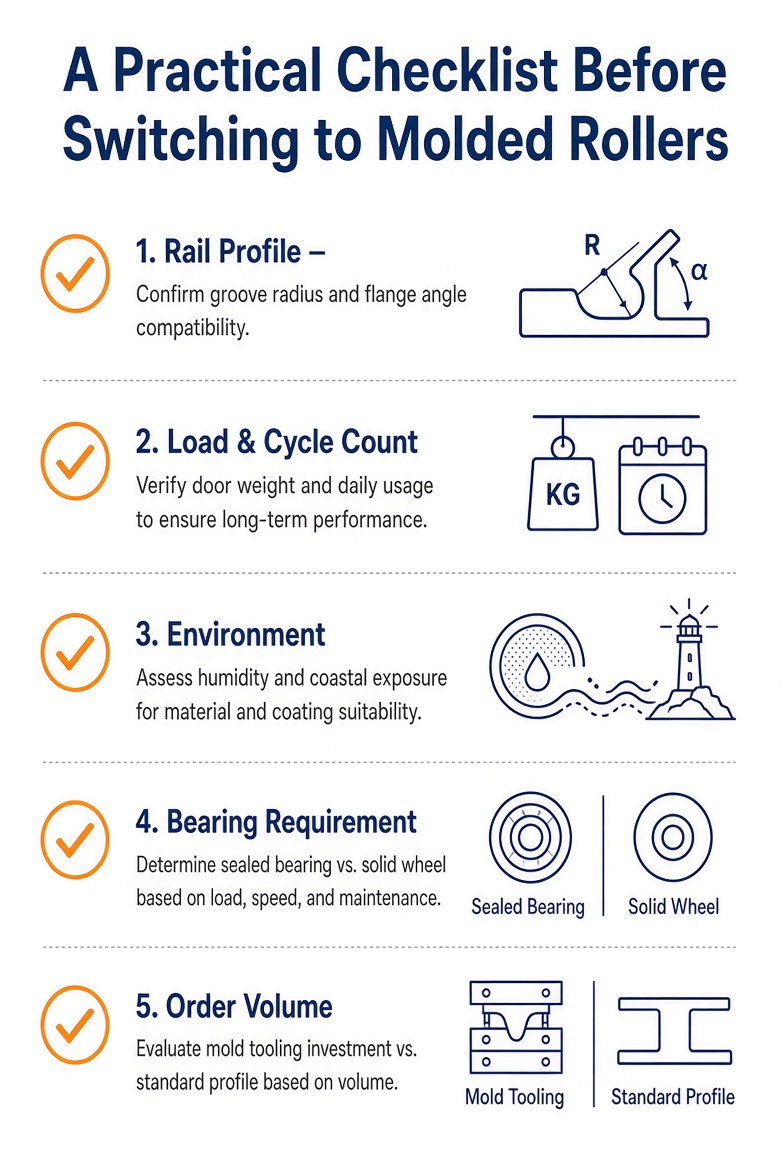
Before specifying or switching to an injection molded roller, it helps to confirm the following:
Frequently Asked Questions
Are injection molded rollers less durable than metal rollers?
Not inherently.
Durability depends on matching resin selection, wall thickness, and design to the actual load and cycle requirements. A well-specified molded roller can outlast a poorly matched metal roller in many residential and light-commercial applications.
Can injection molded rollers handle exterior and coastal environments?
Generally, yes.
They typically perform better than uncoated metal in this specific respect, since engineering plastics do not corrode the way untreated steel does.
Is it expensive to get a custom groove profile with injection molding?
The upfront mold cost is a real factor, but once the mold exists, producing a custom profile costs close to the same as producing a standard one.
The cost difference shows up mainly at low order volumes, not at typical bulk quantities.
Do all injection molded rollers skip the bearing?
No.
Many still use a pressed-in bearing for higher-cycle or heavier-load applications.
A bearing-free design is a specific choice suited to lighter-duty use, not a universal feature of molded rollers.
The Practical Takeaway
The shift toward injection molded rollers in sliding door production comes down to a few well-established factors: forming a part directly to its final shape rather than cutting it, building groove and flange geometry into the mold itself, and taking advantage of engineering plastics' genuine resistance to corrosion and lower baseline friction.
None of this makes molded rollers a universal replacement for metal. For very high loads or extreme environments, metal still holds a clear advantage.
For the majority of residential and light-commercial sliding door applications, however, matching the resin, groove design, and bearing choice to the actual rail and load requirements is what determines whether a molded roller performs the way it is supposed to.